

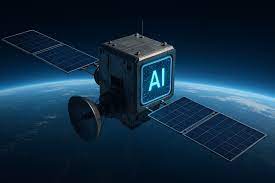
China has unveiled an ambitious plan to assemble a vast constellation of satellites designed to function as an orbital supercomputer powered by artificial intelligence. The project, involving around 2,800 satellites, aims to create an interconnected network in space capable of handling massive amounts of data in real time. Analysts see this as a strategic move that combines space exploration with next-generation AI, signaling China’s determination to lead in both domains.
The initiative is not only about enhancing computing capabilities but also about reducing reliance on Earth-based infrastructure. By placing AI-driven supercomputing nodes in orbit, China intends to process and transmit information faster, with applications ranging from scientific research to defense operations.
How the Orbital AI Network Works
The network is designed to operate as a distributed computing system in low Earth orbit (LEO). Each satellite will act as a node equipped with advanced AI processors, high-speed communication systems, and energy-efficient designs to ensure stable operation in harsh space environments. Collectively, these nodes will form a single, unified system — essentially a supercomputer in the sky.
Unlike traditional ground-based data centers, space-based AI satellites have the advantage of global coverage and reduced latency in certain applications. For instance, real-time image analysis from Earth observation satellites could be processed instantly in orbit without waiting for data to travel back to ground stations. This could drastically improve efficiency in monitoring climate change, natural disasters, or even global internet connectivity.
China’s plan also includes the use of quantum communication technology and advanced encryption to protect data integrity across the constellation, addressing concerns about cybersecurity in space.
Strategic and Economic Implications
The deployment of such a large-scale orbital AI network carries profound implications for geopolitics and global markets. By controlling a distributed AI supercomputer in space, China could gain a significant advantage in fields such as weather forecasting, satellite communications, and autonomous navigation.
From an economic standpoint, the system could support industries like logistics, agriculture, and telecommunications by providing faster data processing and predictive analytics. For the defense sector, analysts warn that the network might offer enhanced surveillance, missile tracking, and real-time battlefield intelligence, reinforcing China’s military capabilities in space.
Furthermore, the project highlights China’s broader ambition to challenge U.S. dominance in both AI and space technology. As global competition intensifies, other nations may accelerate their own projects in orbital computing, potentially sparking a new space race focused on artificial intelligence.
The Future of AI Supercomputing in Space
While still in its early phases, the 2,800-satellite constellation is expected to be deployed gradually over the coming years. Engineers face significant challenges, including maintaining stable communications, managing power efficiency, and ensuring long-term sustainability in orbit. Space debris and orbital congestion also remain pressing concerns, as the deployment of thousands of satellites could exacerbate existing risks.
Nevertheless, experts believe the project represents a glimpse into the future of computing. As artificial intelligence becomes increasingly critical for scientific discovery, climate modeling, and defense, moving supercomputing infrastructure to orbit could become a global trend. If successful, China’s initiative may serve as a blueprint for similar systems worldwide, potentially redefining the relationship between AI and space technology.
China’s orbital AI supercomputer network underscores a new era where the boundaries between Earth and space are increasingly blurred. With thousands of satellites working together as one, the project demonstrates how innovation in space can reshape the way humanity processes information, manages resources, and confronts global challenges.
Source: https://malaka555.sg-host.com/
0 Comments